Industrial Mixers UK
PerMix Applications
Application: Mixing Xanthan Gums
Across the food, beverage, and cosmetics industries, xanthan gum is one of the most widely used hydrocolloids for creating stable emulsions, thickening liquids, and controlling product texture.
However, manufacturers frequently encounter one frustrating issue when introducing xanthan gum into liquids:
Clumping.
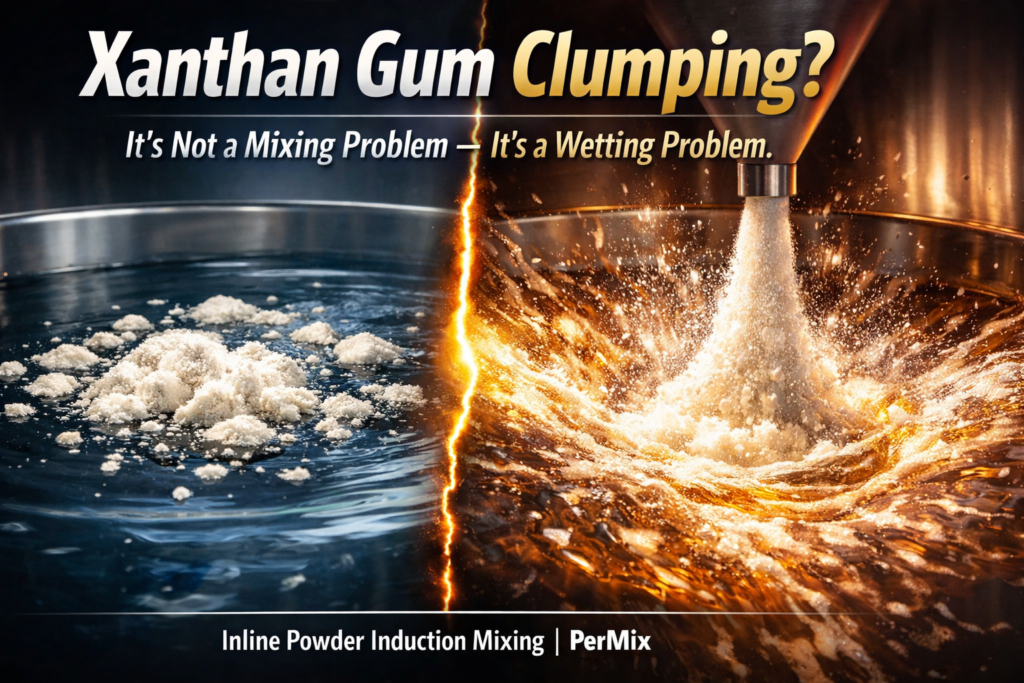
When xanthan gum is added directly to the surface of a liquid inside a mixing vessel, the powder hydrates almost instantly. The outer layer of each particle forms a gel barrier which traps dry powder inside, creating what operators commonly refer to as “fish eyes.”
Once these agglomerates form, they can take a significant amount of time to disperse and hydrate properly.
The result is a production process that often includes:
• Long agitation times
• Inconsistent viscosity development
• Powder lumps that refuse to disperse
• Reduced manufacturing efficiency
This is not usually a problem with mixer power or agitation design.
It is fundamentally a wetting problem.
Xanthan gum is a fast-hydrating polysaccharide. As soon as it contacts water, the outer surface of the powder hydrates and forms a gel layer.
If the powder is not dispersed immediately, this gel layer prevents the remaining powder inside the particle from contacting the liquid.
This creates clumps that require prolonged mixing to break down.
Traditional tank mixing relies on surface addition of powders followed by recirculation. While effective for many ingredients, this method often struggles with hydrocolloids and stabilisers.
To eliminate clumping, powders must be dispersed before they have the opportunity to hydrate.
Inline powder induction mixers solve this challenge by changing where and how powders enter the liquid stream.
Rather than adding powders on top of the liquid surface, powders are introduced directly into a high-velocity rotor-stator mixing zone through a powder induction hopper.
The powder is immediately drawn into the liquid stream and dispersed under intense shear forces before hydration can occur.
This approach delivers several key benefits:
• Immediate wetting of powders
• Elimination of “fish eyes” and agglomerates
• Dramatically reduced batch mixing times
• Improved product consistency
• Dust-free powder addition
Inline powder induction systems are widely used throughout the UK food, beverage, pharmaceutical, and cosmetic industries for dispersing difficult powders such as:
Xanthan gum
Citric acid
Salt (fine or PDV grades)
Trisodium citrate
Starches and stabilisers
Hydrocolloids and thickeners
PerMix designs high-shear inline powder induction mixers that integrate seamlessly into existing process systems.
Installed within a recirculation loop, the system continuously pulls liquid through the mixer while powders are introduced through the induction hopper. The high-shear rotor-stator mixing head instantly disperses the powder into the liquid stream, ensuring fast hydration and uniform dispersion.
For manufacturers producing sauces, beverages, dressings, gels, and cosmetic formulations, this approach significantly improves efficiency while ensuring consistent product quality.
In many cases, processes that previously required extended agitation can be reduced to minutes.
Sometimes the best way to improve mixing performance is not to increase agitation power.
It is to control the exact moment when powder meets liquid.
Stay Connected