Industrial Mixers UK
Jet Mills
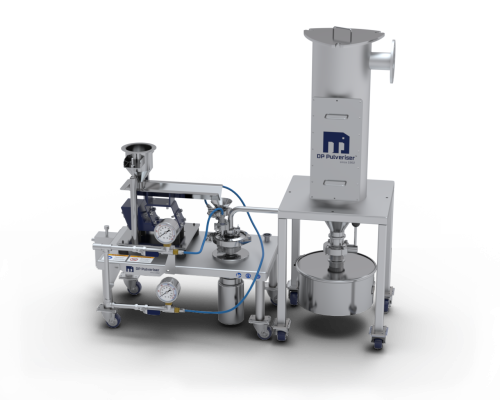
 Jet Mills
Best in Innovation • Best In Performance • Best In Quality • Best In Price • Best In Warranty
Unveiling the Power of Jet Mills: Revolutionizing Particle Size Reduction
Jet mills are advanced grinding systems designed to micronise powders using high-velocity compressed gas rather than mechanical grinding media. This makes them ideal for applications where particle size control, purity, and heat sensitivity matter more than brute force.
On the PerMix UK website, our jet mills—manufactured by DP Pulverizers—are engineered to support pharmaceutical, chemical, food, battery, and advanced materials manufacturers across the UK and Europe who require consistent sub-micron to low-micron particle sizes with minimal contamination.
A jet mill (also called a fluid energy mill) reduces particle size by accelerating particles in a high-velocity gas stream—typically compressed air, nitrogen, or inert gas—until they collide with each other at near-supersonic speeds.
No mechanical grinding tools.
No metal-to-product contact.
No unnecessary heat generation.
Just physics doing the heavy lifting.
Because size reduction occurs through particle-on-particle impact, jet mills are widely used where product integrity, purity, and tight PSD (particle size distribution) control are non-negotiable.
Material is fed into the grinding chamber where multiple gas jets accelerate particles into a controlled vortex. As particles collide, they fracture along natural fault lines. Finer particles migrate toward the centre and exit through an integrated classifier, while oversized particles remain in circulation until they meet the target size.
The result is:
Narrow particle size distribution
Repeatable, controllable micronisation
Excellent batch-to-batch consistency
For UK and EU manufacturers, this level of control is essential for regulatory compliance, formulation performance, and downstream processing.
DP Pulverizers jet mills are engineered for industrial reliability, not just lab curiosity.
They deliver:
Ultra-fine grinding down to sub-micron levels
Low-temperature processing for heat-sensitive materials
No grinding media contamination
Excellent control over top-cut size
Scalability from R&D to full production
Options include:
Integrated dynamic classifiers
Nitrogen or inert gas operation for ATEX and oxygen-sensitive products
Wear-resistant linings for abrasive materials
Sanitary and pharmaceutical-grade construction
This makes them a natural fit for UK manufacturers operating under GMP, ATEX, and CE requirements.
Jet mills are commonly used across Europe in industries where precision matters more than throughput alone:
Pharmaceuticals & APIs – micronisation for bioavailability and dissolution control
Battery & energy materials – cathode/anode powders, graphene, silicon compounds
Chemicals & fine chemicals – pigments, catalysts, speciality additives
Food & nutraceuticals – heat-sensitive ingredients, flavours, functional powders
Advanced materials & R&D – ceramics, polymers, composites
When particle size directly affects performance, jet milling is often the only sensible answer.
PerMix UK provides more than just equipment listings. We support complete milling solutions tailored for UK and EU operations.
That includes:
Application-driven mill selection
Integration with feeding, conveying, and classification systems
Pilot testing and scale-up support
CE, ATEX, and UKCA alignment
Long-term service and technical support
By pairing PerMix UK’s system-level engineering with DP Pulverizers’ milling expertise, customers gain a reliable path from process concept to production reality.
Jet mills are often only one step in a larger processing chain. PerMix UK routinely integrates jet mills with:
Pre-crushing or conditioning mills
Air classification systems
Mixing, blending, and conditioning equipment
Dust-controlled feeding and discharge solutions
This allows UK manufacturers to optimise not just particle size—but the entire process flow.
Choosing the right jet mill is less about catalogue specs and more about understanding what the material needs to become by the time it exits the system. Particle size targets, heat sensitivity, explosivity, and throughput all pull on the design in different directions.
Here’s how UK and EU manufacturers typically narrow it down.
Jet mills shine when ultra-fine control is required. Before anything else, define:
Your target d50 and d97 (median and top-cut particle sizes)
How tight the particle size distribution must be
Whether fines overproduction is acceptable or a problem
For sub-10 micron and sub-micron applications, jet milling is usually the correct technology. For coarser outputs, pairing a jet mill with a pre-mill or air classifier often delivers better energy efficiency.
If your product degrades, melts, oxidises, or loses functionality with heat, jet milling immediately moves to the top of the shortlist.
Because jet mills rely on gas expansion rather than mechanical friction, product temperatures remain significantly lower than in mechanical mills. This is especially important for:
APIs and pharmaceutical intermediates
Nutraceuticals and functional food ingredients
Battery materials and polymers
Volatile or low-melting-point compounds
For oxygen-sensitive materials, inert gas operation becomes essential rather than optional.
One of the most important configuration decisions is the grinding gas.
Compressed air is suitable for many inert materials and lower-risk applications.
Nitrogen or inert gas should be selected when:
Products are explosive or combustible
Oxidation must be prevented
ATEX zoning applies
Battery, metal, or advanced materials are involved
Jet mills from DP Pulverizers are designed to support both air and inert gas systems, allowing future-proofing as regulations or formulations evolve.
Jet mills are precision tools, not blunt instruments. Higher throughput typically trades off against ultra-tight classification.
Key questions to answer:
Is this an R&D, pilot, or production system?
Will the formulation change frequently?
Is consistency more important than maximum capacity?
Many UK manufacturers opt for systems that scale cleanly from lab to production using the same milling principle, reducing revalidation and process risk.
Highly abrasive materials demand attention to internal linings and wear zones.
Options such as:
Ceramic or hardened liners
Optimised nozzle geometry
Reduced internal turbulence
extend service life and protect particle purity—especially important in pharmaceutical, battery, and advanced materials applications.
In the UK and EU, compliance isn’t an afterthought—it’s a design input.
Jet mill selection must align with:
CE and UKCA requirements
ATEX zoning (where applicable)
GMP and sanitary design expectations
Dust containment and operator safety
Selecting a mill that already meets these expectations avoids expensive retrofits later.
Jet mills rarely operate in isolation.
A strong selection process considers:
Feeding accuracy and flowability
Upstream size conditioning
Downstream classification or blending
Dust collection and containment
Cleaning, changeover, and maintenance access
PerMix UK routinely supplies jet mills as part of fully integrated milling, mixing, and material handling systems, ensuring the mill works with the process—not against it.
The best jet mill is not the biggest, fastest, or most expensive—it’s the one that:
Hits your particle size target reliably
Protects product integrity
Meets regulatory requirements
Scales with your business
Jet milling is applied physics with commercial consequences. Get the physics right, and the business tends to follow.
Jet mills are selected when particle size directly influences performance, stability, or regulatory acceptance. Across the UK and Europe, manufacturers rely on jet milling technology to achieve ultra-fine, consistent powders while protecting material integrity.
Jet mills supplied through PerMix UK and manufactured by DP Pulverizers are used in industries where mechanical grinding simply introduces too much heat, wear, or variability.
In pharmaceutical manufacturing, particle size is not cosmetic—it affects bioavailability, dissolution rate, stability, and dose uniformity.
Jet mills are widely used in the UK & EU for:
API micronisation and de-agglomeration
Inhalation and pulmonary drug formulations
Controlled PSD for tablets and capsules
Heat- and shear-sensitive compounds
Because jet mills operate without grinding media, they minimise contamination risk and align naturally with GMP-driven environments.
Europe’s rapid growth in battery and energy material research has driven strong demand for precision milling technologies.
Jet mills are commonly used for:
Cathode and anode powders
Silicon- and graphite-based materials
Graphene and advanced carbon materials
Specialty ceramic and conductive powders
Inert gas jet milling enables safe processing of combustible or oxygen-sensitive materials, supporting ATEX-compliant operations and advanced R&D workflows.
For chemical manufacturers, consistency and purity often matter more than raw throughput.
Jet milling supports:
Pigments and colour concentrates
Catalysts and catalyst supports
Specialty additives and intermediates
Functional fillers and modifiers
Tight particle size control improves reaction rates, dispersion, and downstream process stability.
While not every food application requires jet milling, it becomes essential when heat damage or flavour loss must be avoided.
Typical UK & EU applications include:
Functional ingredients and extracts
Heat-sensitive nutraceutical powders
Flavours and aroma compounds
Specialty dietary ingredients
Jet mills help preserve volatile compounds while producing uniform, free-flowing powders.
Jet mills are a staple of R&D environments because they allow repeatable scale-up without changing milling principles.
They are widely used for:
Process development and feasibility studies
Material science research
Scale-up validation before production investment
Multi-product facilities with frequent changeovers
Many UK organisations start with pilot-scale jet mills before transitioning seamlessly into production systems.
Across industries, jet mills are chosen when:
Sub-10 micron or sub-micron sizes are required
Heat and shear must be minimised
Purity and contamination control are critical
Tight PSD control impacts product performance
Regulatory compliance is non-negotiable
Jet milling isn’t about brute force. It’s about controlled energy applied intelligently.
Jet mills are most effective when engineered as part of a complete process. PerMix UK regularly integrates jet mills with:
Pre-milling and conditioning stages
Air classification systems
Powder mixing and blending equipment
Dust-controlled feeding and discharge
Turn-key milling and material handling lines
This systems-first approach ensures the mill enhances the process rather than becoming a bottleneck.
PerMix is here to listen to your needs and provide sustainable solutions. Contact us to discover more.