Industrial Mixers UK
Air Classifiers
 Air Classifiers
Best in Innovation • Best In Performance • Best In Quality • Best In Price • Best In Warranty
Unlocking Precision: The Ultimate Guide to Air Classifiers in Industrial Processes
Air classifiers and air classifying mills are used across the UK and Europe to achieve tight particle size control, improved yield, and consistent powder performance—without relying on screens or sieves.
PerMix UK supplies both standalone air classifiers and integrated air classifying mills manufactured by DP Pulverizers, supporting manufacturers who require precision separation, controlled grinding, or both in a single system.
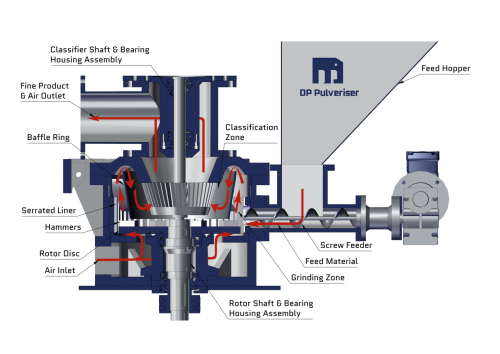
An air classifying mill combines mechanical grinding and dynamic air classification into a single, compact system.
Instead of grinding everything and sorting later, an ACM:
Grinds material using a high-speed rotor
Classifies particles internally using an air classifier
Continuously returns oversized particles for further grinding
Discharges only material that meets the target particle size
This creates a closed-loop milling system that delivers uniform, repeatable particle size distribution in one pass.
Material enters the milling chamber and is impacted by a high-speed rotor. As particles are reduced in size, they are immediately exposed to an internal classifier wheel.
Inside the ACM:
Fine particles pass through the classifier and exit as finished product
Oversized particles are rejected and remain in the grinding zone
Rotor speed and airflow define the final cut point
This continuous internal feedback loop prevents over-grinding and produces a narrow, controlled PSD.
Both technologies rely on airflow and centrifugal forces—but they serve different process goals.
Best when:
Particle size separation is needed without further grinding
Existing mills are already installed
Yield optimisation is the primary goal
Over-grinding must be reduced
Often used downstream of jet mills, pin mills, or hammer mills.
Best when:
Grinding and classification are required together
A compact footprint is important
Consistent PSD must be achieved in a single step
Energy efficiency and process simplicity matter
ACMs are especially popular in food, chemical, mineral, and pharmaceutical applications where repeatability and throughput must coexist.
Air classifying mills from DP Pulverizers are engineered for industrial stability and fine control, offering:
Integrated grinding and classification
Adjustable cut points without hardware changes
Narrow particle size distribution
Reduced fines generation
Lower energy consumption compared to multi-stage systems
Continuous operation with predictable output
Available options include:
Wear-resistant designs for abrasive materials
Sanitary and pharmaceutical-grade construction
ATEX-compliant configurations
Integration with feeding, conveying, and dust collection systems
Air classifiers and ACMs are widely used where particle size consistency directly impacts product performance.
Flours and starches
Sugars and sweeteners
Spices and functional ingredients
API conditioning
Excipient processing
PSD control for dosage uniformity
Pigments and dyes
Fillers and additives
Chemical intermediates
Calcium carbonate
Talc and silica-based materials
Performance minerals for coatings and plastics
Cathode and anode powders
Graphite and carbon materials
R&D-scale and production classification
Air classifiers and ACMs are often part of closed-loop or turn-key milling systems, integrated with:
Jet mills for ultra-fine grinding
Pin mills for controlled fine grinding
Pre-breakers or coarse mills
Powder mixing and blending systems
Dust-controlled material handling
PerMix UK engineers these systems holistically, ensuring each component supports the overall process rather than creating bottlenecks.
Air classifiers and ACMs are the right choice when:
Tight PSD control is required
Screens are impractical or unreliable
Over-grinding must be avoided
Yield and consistency drive product value
In many UK & EU operations, air classification is the difference between producing powder—and producing specification.
Choosing between an air classifier and an air classifying mill is less about brand or size and more about what problem you’re trying to solve: separation, grinding, or both—under real production conditions.
Below is the practical framework UK & EU manufacturers use to choose correctly the first time.
This is the most important question.
If your material is already milled but the particle size distribution is too wide, inconsistent, or out of spec, you likely need a standalone air classifier.
If your material still needs size reduction and tight PSD control, an air classifying mill (ACM) is usually the smarter choice.
In short:
Classifier = separation only
ACM = grinding + separation in one system
Misidentifying this step is the most common (and expensive) mistake.
Air classifying technology excels when top-cut control matters.
You should clearly define:
Target cut size (e.g. d97 or d99)
Acceptable fines content
How tight the PSD must be batch to batch
Air classifiers and ACMs allow cut point adjustment via airflow and rotor speed, making them ideal for processes where specifications may evolve over time.
If you need sub-micron control, jet milling may be more appropriate. If consistency and yield are the priority, air classification is often the better tool.
Material properties strongly influence system selection.
Consider:
Is the material brittle or friable?
Is it abrasive?
Does it smear, melt, or soften with heat?
Is it hygroscopic or sticky?
Brittle, dry materials are ideal for both classifiers and ACMs. Sticky or heat-sensitive materials may require cooling, conditioning, or alternative milling upstream.
This is where experience matters more than datasheets.
Air classifying systems scale well, but there is always a balance.
Ask:
Is this R&D, pilot, or production?
Is throughput more important than ultra-tight PSD?
Will multiple SKUs run on the same system?
ACMs are excellent when consistent output and throughput must coexist. Standalone classifiers are often chosen when yield optimisation and fine control matter more than speed.
Your current process matters.
Choose a standalone air classifier if:
You already have a jet mill, pin mill, or hammer mill
You want to improve yield without replacing equipment
You need flexible classification downstream
Choose an ACM if:
You want a compact, single-step solution
You are designing a new line
You want to avoid multi-stage milling complexity
Many UK manufacturers start with classifiers, then move to ACMs as production volumes grow.
For abrasive or regulated applications, design details matter.
Look for:
Wear-resistant linings and rotors
Tool-less or quick-access designs
Sanitary construction where required
Predictable maintenance intervals
Systems from DP Pulverizers are engineered with serviceability in mind—because downtime is usually more expensive than capital equipment.
Your final selection must align with:
CE and UKCA requirements
ATEX zoning (if applicable)
Dust containment and explosion mitigation
GMP or hygienic design expectations
Choosing a compliant system from the start avoids costly retrofits and revalidation later.
Choose a Standalone Air Classifier when:
Grinding is already complete
PSD correction is the goal
Yield optimisation matters
Flexibility across products is required
Choose an Air Classifying Mill (ACM) when:
Grinding and classification are both required
Space and system simplicity matter
Consistent PSD must be achieved in one pass
Energy efficiency is important
The “best” air classification system is the one that:
Meets your particle size spec reliably
Integrates cleanly with your process
Scales with your production needs
Stays compliant as regulations tighten
Air classification is not about separating particles—it’s about controlling outcomes.
When manufacturers search for milling equipment, they’re rarely asking “What machine is best?”
They’re really asking: Which technology solves my problem with the least risk, waste, and compromise?
This guide compares the four most commonly confused technologies—air classifiers, air classifying mills, jet mills, and pin mills—so UK & EU manufacturers can make confident, process-driven decisions.
Best for: Particle size separation without grinding
An air classifier does not reduce particle size. It separates particles based on size, shape, and density using airflow and centrifugal forces.
Choose an air classifier when:
Material is already milled
PSD is too wide or inconsistent
Over-grinding must be avoided
Yield improvement is the priority
Screens are clogging or unreliable
Typical role in the process:
Quality control and yield optimisation
Air classifiers are often paired with jet mills, pin mills, or hammer mills as a downstream refinement step.
Best for: Grinding + classification in one controlled step
An ACM combines mechanical grinding with internal air classification. Oversized particles are automatically rejected and re-ground until they meet spec.
Choose an ACM when:
You need fine grinding and tight PSD
You want a compact, single-stage solution
Energy efficiency matters
Over-grinding must be controlled
Consistent output is critical
Typical role in the process:
Primary milling with built-in quality control
ACMs are extremely popular in food, chemicals, minerals, and pharmaceutical processing across the UK & EU.
Best for: Ultra-fine and sub-micron grinding with minimal heat
Jet mills use high-velocity gas (air or nitrogen) to create particle-on-particle collisions—no mechanical grinding tools.
Choose a jet mill when:
Sub-10 micron or sub-micron sizes are required
Heat must be minimised
Product purity is critical
Contamination cannot be tolerated
Inert gas or ATEX operation is required
Typical role in the process:
High-precision micronisation
Jet mills are common in pharmaceuticals, battery materials, advanced ceramics, and high-value R&D applications.
Best for: Fine grinding with high throughput and simplicity
Pin mills use high-speed rotating pins to apply controlled impact and shear.
Choose a pin mill when:
Fine grinding (not sub-micron) is required
Throughput matters
Operating simplicity is important
De-agglomeration is needed
Energy and operating cost must be controlled
Typical role in the process:
Efficient, repeatable fine grinding
Pin mills sit comfortably between hammer mills and jet mills in terms of precision and complexity.
Need separation only? → Air Classifier
Need grinding + separation? → ACM
Need ultra-fine, heat-free micronisation? → Jet Mill
Need fine grinding with high throughput? → Pin Mill
Modern UK & EU plants rarely rely on a single machine.
Common combinations include:
Jet mill + air classifier (precision + yield)
Pin mill + air classifier (throughput + control)
ACM as a standalone solution
Pre-mill + jet mill for staged size reduction
The smartest systems are designed around material behaviour, not marketing labels.
The right choice depends on:
Target particle size and PSD
Heat sensitivity and material behaviour
Throughput requirements
Regulatory and safety constraints
Integration with upstream and downstream processes
This is where experience matters more than brochures.
PerMix UK supports air classification and milling systems manufactured by DP Pulverizers, engineered to work as part of complete, compliant, and scalable processing lines across the UK and Europe.
Grinding makes particles smaller.
Classification decides which particles are acceptable.
The best milling systems do both intelligently, with as little wasted energy and product as possible.
PerMix is here to listen to your needs and provide sustainable solutions. Contact us to discover more.